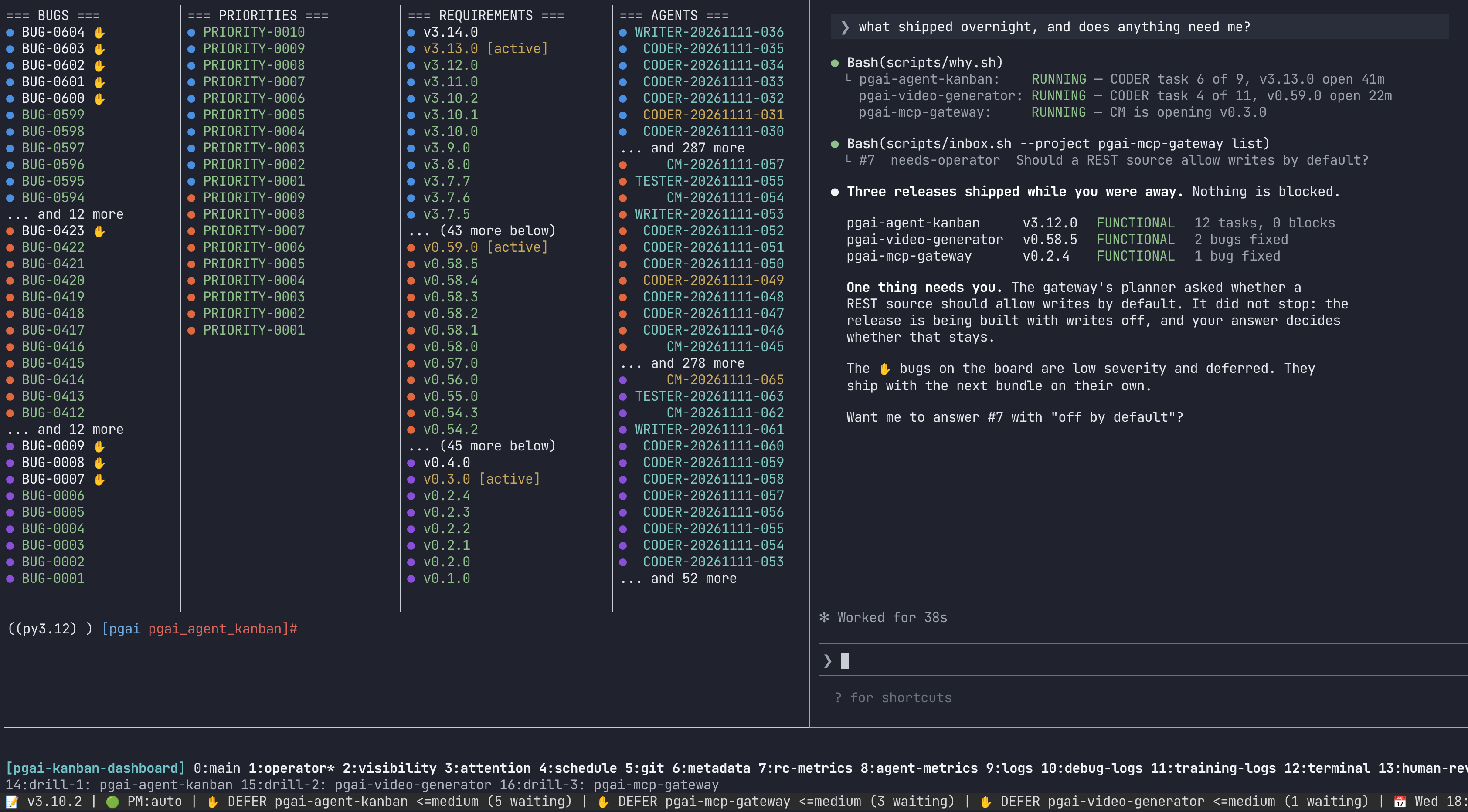
How It Works
You write a requirements document. The kanban does the rest, one release at a time per repository, on purpose.
The Team You Get
The Road So Far
The releases that mattered most. Each one was built by the one before it.
The core loop: a requirements document in, a tagged release out. Role agents, cron, a terminal dashboard. Builds itself from day one.
Workflows become plugins (release, document, testing-only). Operator REST API. OVERWATCH and the PO intake agent arrive.
Resilient autonomy: findings become bugs for the next loop, not reasons to stop. Blocks resolve themselves.
Walk away from it: why.sh, an API twin for every operator verb, ship by default, small bugs bundled.
It stops stopping: operator inbox, OVERWATCH decisions and runaway detection, provider-error retries, your own test runners and release hooks.
The operator's workbench: Claude Code or Codex beside the board, with skills, so you instruct instead of typing commands. Time limits on hooks. Reset keeps work.
The code graph: agents look your code up in a map of the repository instead of searching it.
Six of eight public releases, and what is planned. Every release and its notes are in the repository.
What v3.5 Gives You
In production. Not planned.
- Ships by default, with a release status you can read; never a silent stall
- Questions go to an inbox; the chain keeps moving
- OVERWATCH fixes mechanical blocks and stops runaways
- Your test commands in every task's acceptance criteria
- Release hooks for your own release steps, time-limited
- A cockpit with Claude Code or Codex beside the board
- Skills, so that assistant already knows the kanban
- Reset keeps committed work
- Containers that start with a proper init and stay healthy
- One line answers "why isn't it moving?", with the fix attached
Built the Right Way
The size and discipline behind the thing you would be trusting, at this release.
| BASH | PYTHON | TOTAL | |
|---|---|---|---|
| PRODUCTION | 60,000 | 132,000 | 192,000 |
| UNIT TESTS | — | 217,000 | 217,000 |
| INTEGRATION TESTS | — | 49,000 | 49,000 |
| FIXTURES AND OTHER TESTS | 1,000 | 27,000 | 28,000 |
| TOTAL | 61,000 | 425,000 | 486,000 |
More test code than product code: about 1.5 lines of test for every line that ships.
A long bug list is the standard being enforced, not the product breaking. A bug here is anything the tester can show is wrong, and that includes a misspelled message or a stale line of documentation. Most are fixed in a few lines.
What It Costs
Measured from real token records, not estimated.
Run It
$ git clone https://github.com/purdygood-ai/pgai-agent-kanban.git
$ cd pgai-agent-kanban
$ pip install -r requirements.txt
$ ./install.sh
# then walk the ten-minute demo: a requirements document in, a tagged release out
$ less team/demos/helloworld-demo/README.md
Four complete demos ship in the repository with every input file included: hello world, an arcade game built release by release, a children's story through the document workflow, and an audit of any repository. Everything is open: docs, role files, workflow definitions.
Future Plans
The next features planned. Nothing is claimed until it ships.
- A code graph for the agentsWhere your code is, what calls it, what it calls. Lookups instead of scans: fewer missed callers and fewer tokens per task, measured. Built and running in our own shop.
- The walk-away runFifty or more requirements on a new project with no human interaction. The bar this was built for. Not yet claimed.
- More providers, on demonstrated needOne full release under a provider before it is claimed.